By Lin Xi (Independent Chinese Scholar and Private Entrepreneur)
Beijing’s Nostalgia for “Joint Public-Private Ownership”: What Three Party Media Pieces Signal for China’s Private Sector
In mid-June 2026, China’s two flagship state media outlets ran a trio of retrospectives on Communist Party economic history. Xinhua published a long piece on June 19 celebrating the “Three Great Transformations” of the 1950s as a landmark social revolution. People’s Daily followed on June 20 and 21 with companion pieces revisiting the same era and the Party’s subsequent search for a development path suited to Chinese conditions.
The timing struck many overseas commentators as pointed. Some readers took the pieces as a positive signal about private enterprise. Others read them against the backdrop of today’s tightening political and economic climate and worried aloud that the government might again be laying rhetorical groundwork to absorb private assets under the old banner of “joint public-private management.”
To help readers judge which reading is closer to the mark, it’s worth revisiting what actually happened the first time the Party used that language — and what became of the businesses and business owners caught up in it.
How “Joint Public-Private Ownership” Actually Worked
After the Communist Party took power in 1949, it initially allowed private commerce and industry to continue operating alongside the new state sector, publicly describing its approach as one of “utilizing, restricting, and transforming” capitalist business. That stated tolerance did not last long.
Starting in December 1951, the Party launched the “Three-Anti/Five-Anti” campaigns. The Three-Anti campaign targeted corruption, waste, and bureaucratism inside state organs and the military. The Five-Anti campaign, aimed squarely at private business owners, targeted bribery, tax evasion, fraud against the state, cutting corners on contracts, and leaking economic intelligence. In practice this meant public denunciation rallies, forced confessions, and physical abuse of merchants and factory owners, who were increasingly cast as class enemies. Some accounts put Shanghai’s suicide toll from the campaign at over 800 people in the first four months of 1952 alone, including entire families who died together. The campaign wound down by October 1952, having badly disrupted commercial life in many cities.
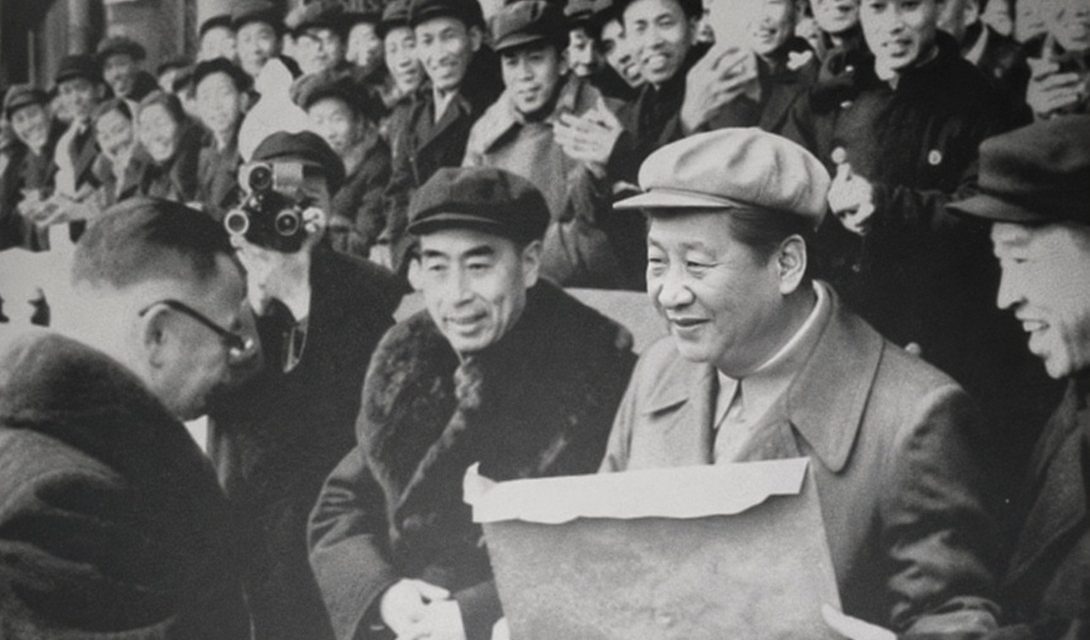
Between 1953 and 1956, the Party moved to the next stage: the “Three Great Transformations” of agriculture, handicrafts, and private industry and commerce. Through a series of policy documents — an official statement on regulating capitalist business in mid-1953, a provisional ordinance on joint enterprises in 1954, and the country’s first constitution later that year — the state formally established the dominance of state-owned enterprise and set out a program for steadily replacing private ownership with collective ownership.
By early 1956, this had escalated into a nationwide wave in which entire industries, not just individual firms, were folded into joint public-private management. The process typically unfolded in stages: a private firm first became jointly owned by the state and its original proprietors; the original owners were then pushed out of day-to-day management; and profits were reallocated under a formula that left a shrinking share for the original shareholders. After 1956, that share was replaced entirely by a fixed annual dividend — nominally 5% of the assessed value of the former owner’s stake, set unilaterally by the government regardless of how profitable the business actually was, and generally below what a bank savings account would have earned. Intangible assets like trademarks, brand reputation, and trade secrets were not counted in the valuation at all.
The distillery that became Kweichow Moutai offers a vivid illustration of how this played out in practice. Its predecessor businesses were three separately owned distilleries. One owner was executed in 1952 on a weapons charge, and his distillery was confiscated with only a token payment. The other two were compulsorily “purchased” for a few tens of thousands of yuan combined. All three were merged into what became a state-owned distillery in Guizhou — today the world’s most valuable liquor company, worth well over a trillion yuan.
By some estimates, more than 120,000 private firms were pushed into joint ownership over this three-year span.
From “Dividend” to Nothing
The government had originally promised these fixed dividend payments for ten years. When that decade lapsed in September 1966, payments simply stopped, and the jointly owned enterprises were reclassified as fully state-owned — with no further compensation and no legal process. In effect, whatever residual claim former owners still held on their old businesses vanished overnight.
That timing coincided almost exactly with the start of the Cultural Revolution, during which former capitalists were targeted again — this time far more violently. Red Guards ransacked the homes of former business owners, seizing cash, jewelry, art, and antiques; families were driven out of their homes and sent to the countryside for forced labor; individuals were paraded in public wearing tall dunce caps and forced into humiliating physical positions, beaten, and in many documented cases killed. Their children faced discrimination in schooling, employment, and marriage prospects for years afterward. Nationwide, estimates suggest over ten million households had their homes searched and property confiscated during the “Destroy the Four Olds” campaign of 1966, with the total value of seized assets estimated in the hundreds of billions of yuan.
After the Cultural Revolution ended, the question of restitution came up periodically but went nowhere. A 1979 Party document allowed former owners to claim any dividend payments technically owed to them before September 1966 — but a separate Ministry of Finance directive that same year specified that the underlying shares themselves would not be returned. A joint 1983 notice from the United Front Work Department and the Ministry of Commerce confirmed that all formerly private assets absorbed through joint ownership, including real estate, now belonged to the state outright and would not be given back. Subsequent lawsuits by former shareholders or their descendants uniformly failed on the strength of these policy documents. Some legal scholars have pointed out the underlying inconsistency: if the state was paying dividends on private shares for over a decade, it was implicitly acknowledging those shares still belonged to someone — and the mere cessation of payment doesn’t, on its own, transfer ownership.
The Third Plenum of the 11th Party Congress in December 1978 marked the formal pivot away from this era, shifting the Party’s stated priorities toward economic development and opening China to reform. From that point on, the Party adopted a much more permissive stance toward private enterprise — a shift covered at length elsewhere.
Why Revive This History Now?
Set against that background, the choice by Xinhua and People’s Daily to devote three major pieces in a single week to celebrating the Three Great Transformations reads, to many observers, as more than routine historical commemoration. Analysts interviewed by various outlets see it as consistent with a broader leftward drift in the Party’s rhetoric, and possibly as advance messaging ahead of a coming Party congress. Few believe it signals literal plans for a new round of nationalizations; more likely, it fits into Xi Jinping’s messaging that the pre-reform and post-reform eras of Party history should not be played off against each other — the so-called “two no-negations” — and into broader propaganda supporting the opening year of the next five-year plan.
Still, the anxiety the articles triggered is not baseless. It reflects a longer-running unease among Chinese entrepreneurs about how secure private property rights actually are under an increasingly assertive Party-state. That unease has shown up in capital flows: by some industry estimates, Chinese households and firms have been moving hundreds of billions of dollars a year out of the country, with one recent annual figure cited as exceeding $800 billion, alongside a steady outflow of high-net-worth individuals relocating abroad.
Private firms in China continue to report systematically worse treatment than state-owned counterparts across licensing and market access, financing, taxation, courts, environmental and safety enforcement, public tenders, and hiring — a pattern that leaves private business owners more exposed both financially and personally even as, on paper, the private sector now accounts for a majority of tax revenue, GDP, innovation output, urban employment, and the overwhelming majority of registered businesses (a set of figures commonly summarized in China as “56789”).
Some observers also point to China’s 2021 revision of its National Defense Mobilization Law, which grants the state sweeping authority to requisition private assets during a declared state of emergency — a legal mechanism that, in the event of a Taiwan Strait crisis or domestic political upheaval, could in theory be used to nationalize targeted industries without going through normal legislative channels. That possibility alone contributes to a sense of unease among private businesspeople about how exposed they might be to sudden shifts in policy.
Given how central the private sector now is to China’s actual economic output, a literal repeat of 1950s-style nationalization seems unlikely in the near term. But the willingness of state media to celebrate the earlier episode — one that, as the historical record shows, ended in the effective erasure of private ownership without compensation or legal process — is itself a data point worth private entrepreneurs’ attention. It suggests a governing mindset that continues to treat the private sector as something that can, in principle, be consolidated or redirected by policy fiat whenever the Party judges it necessary.
Lin Xi, is a Chinese private entrepreneur and director of the Private Entrepreneurs’ Rights Defense Project at Citizen Power.
This piece was translated from Yibao Chinese. If republished, please be sure to add the source and link https://www.yibao.net/?p=248090&preview=true before the text when reposting.