The answer is not merely religion — it is the ultimate contest over power, legitimacy, and national identity
By Lin Xi (Independent Chinese Scholar and Private Entrepreneur)
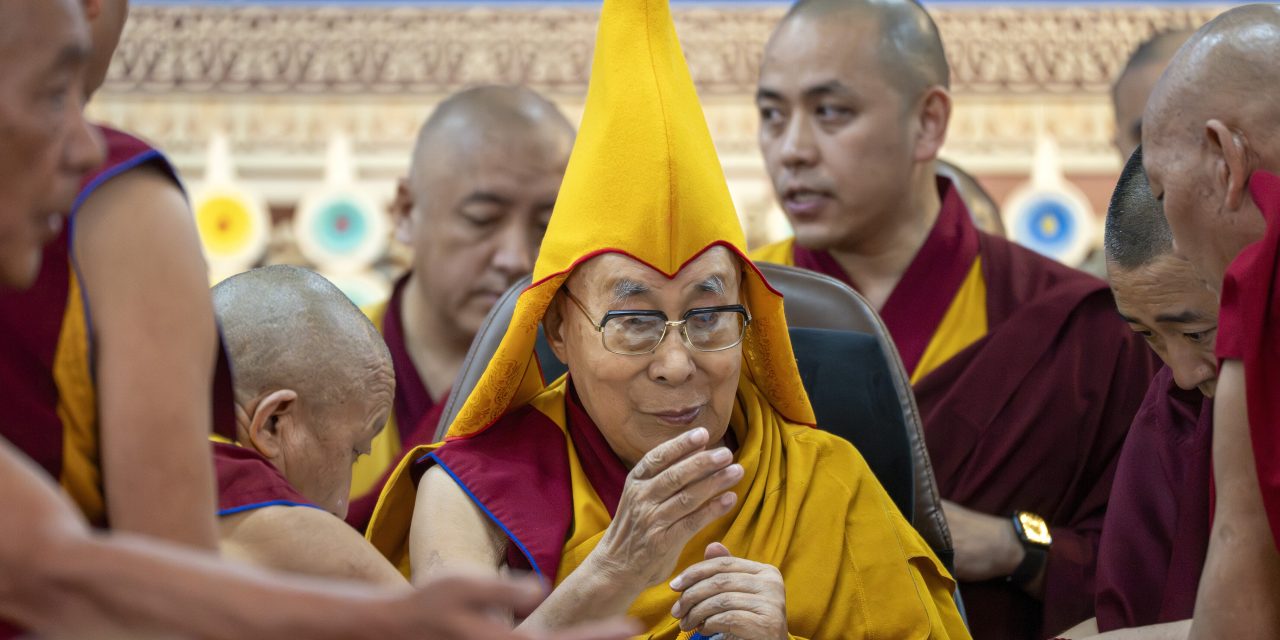
This year, the 14th Dalai Lama celebrates his 91st birthday. At last year’s 90th birthday celebrations, during the opening ceremony of an important religious conference held in Dharamsala, India, the Dalai Lama spoke via video and once again made clear: “The institution of the Dalai Lama will continue,” and “no one has the right to interfere in this matter.”
These words sounded calm, yet nearly every one of them was directed squarely at Beijing.
For it is the Chinese Communist Party — and only the CCP — that has spent decades attempting to intervene in, and even seize control of, the Tibetan Buddhist reincarnation system.
In fact, Beijing has been laying the groundwork on the Dalai Lama’s reincarnation for many years. Through law, propaganda, historical research, ideological remodeling, religious control, and the shaping of international opinion, the CCP is attempting to accomplish something entirely unprecedented: enabling an avowedly atheist communist regime to claim the authority to determine the “reincarnated soul” of Tibetan Buddhism’s highest spiritual leader.
This is not only one of the most absurd power grabs in modern political history — it is also a long-term strategy aimed at reshaping the future of Tibet.
And at the heart of that strategy lies not religion itself, but the question of who owns Tibet.
I. Why the Dalai Lama Once Considered Ending the Reincarnation Institution
Over the past decade or more, the Dalai Lama has publicly stated on multiple occasions that the institution of the Dalai Lama might one day come to an end.
As early as September 24, 2011, he issued a formal statement proposing that “whether the Dalai Lama institution continues should be decided by the Tibetan people.” In subsequent interviews in 2014, 2019, and 2024, he again suggested that “this institution may no longer be necessary.”
Many have wondered: why would a religious leader representing over six hundred years of tradition seriously consider voluntarily ending his own reincarnation lineage? The reason is not complicated. The Dalai Lama fears that the CCP will exploit the reincarnation system to install a “fake Dalai Lama,” thereby controlling Tibetan Buddhism and, through it, Tibet itself. This concern is far from paranoia — because Beijing has already done exactly this, once before.
In 1995, following the passing of the 10th Panchen Lama, the Dalai Lama identified Gedhun Choekyi Nyima as the 11th Panchen Lama in accordance with tradition. The CCP swiftly rejected this recognition and secretly removed the six-year-old boy and his family. The child — recognized by Tibetans as the true Panchen Lama reincarnate — subsequently vanished from the world, and his whereabouts remain unknown to this day. Beijing then installed its own chosen candidate, Gyaincain Norbu, as the “official Panchen Lama.” This episode left an extraordinarily deep wound in Tibetan society.
It signaled that the CCP was no longer content with controlling monasteries, land, and political institutions — it had begun directly intervening in the most sacred spiritual dimension of Tibetan Buddhism. The Dalai Lama has remained acutely vigilant about this.
In a 2019 BBC interview, he stated plainly: “If after my death China appoints a fake Dalai Lama, Tibetans will not accept it, and it will destroy the sanctity of this institution.”
He therefore considered simply ending the Dalai Lama reincarnation lineage entirely, to prevent the CCP from using a “fake reincarnate” to steal religious legitimacy. In recent years, however, his position has shifted. The reason is that an outpouring of requests — from Tibetans inside Tibet, from exile communities, and from Tibetan Buddhist practitioners in Mongolia, Russia, and China — have urged that the institution continue.
He ultimately decided: the institution of the Dalai Lama will continue. But he emphasized simultaneously that the future process of recognizing the reincarnation will be handled entirely by the Dalai Lama’s office — the Gaden Phodrang Foundation — and that no political force has any right to interfere. More crucially, he has long maintained one position: the next Dalai Lama will not be born in China. This means that even with all the power of the state apparatus, Beijing may simply never gain access to the reincarnate truly recognized by Tibetans.
II. Why Does an Atheist Regime Care So Much About “Reincarnation”?
Following the Dalai Lama’s remarks, Beijing responded immediately. Foreign Ministry spokesperson Mao Ning stated that the reincarnation of “living Buddhas” such as the Dalai Lama must receive approval from the central government and must follow historical traditions such as the “golden urn lottery” and “central government approval.”
This claim is, in itself, deeply absurd. The reincarnation of living Buddhas has always belonged to the realm of religious belief, unrelated to secular political authority. The CCP in particular has long adhered to atheism and publicly criticized religion as “backward superstition” — and yet it now suddenly asserts that it holds the authority to determine who may “reincarnate.”
This borders on political black comedy. In 2007, the State Administration for Religious Affairs promulgated the Management Measures for the Reincarnation of Living Buddhas of Tibetan Buddhism — the notorious “Order No. 5.” Article Four stipulates: “Those whom the government deems should not reincarnate shall not reincarnate.” When this provision was first published, it drew widespread mockery from the international community. It amounted to a declaration that “whether a soul may reincarnate requires Communist Party approval.”
The problem, of course, is this: if reincarnation truly exists, how could any government possibly stop it? At most, the state could “refuse to recognize” a reincarnation — it could never actually prevent one in any religious sense. And the contradiction runs even deeper: the CCP holds aloft the banner of atheism with one hand while eagerly deciding who counts as a “reincarnated living Buddha” with the other. This is a profound logical contradiction.
The Dalai Lama himself has responded to this with characteristic wit. He once remarked: “If the CCP wants to interfere in the Dalai Lama’s reincarnation, they should first acknowledge the existence of reincarnation — and then begin by finding the reincarnations of Mao Zedong and Deng Xiaoping.”
Behind that joke lies an extraordinarily sharp political critique. For what the CCP truly wants to control has never been religion — it is the social influence that religion carries.
III. Why the CCP Must “Capture” the Dalai Lama’s Reincarnation
Many people mistakenly assume that Beijing’s obsession with the Dalai Lama’s reincarnation is a religious matter. It is not, at all. The real issue is: who represents Tibet.
The Dalai Lama is not merely a religious leader — he is the central symbol of Tibetan national identity. Over the past several decades, the CCP has poured enormous resources into maintaining stability in Tibet: military and police systems, surveillance technology, educational transformation, language policy, monastic management, cadre-in-monastery programs, boarding schools…
And yet, despite all of this, Beijing has never been able to genuinely win the hearts of the Tibetan people. When Mao Zedong learned that the Dalai Lama had fled to India, he reportedly recognized: “China has lost the key to controlling Tibet.” Subsequent history has, in a certain sense, borne this out. More than sixty years on, the Dalai Lama remains the most important spiritual symbol for Tibetans, while the many “official religious figures” installed by Beijing have consistently failed to earn genuine reverence.
The CCP has therefore arrived at a conclusion: if the institution of the Dalai Lama cannot be destroyed, it must be controlled. Hence, Beijing has focused its efforts on “controlling the reincarnation.” For within the Tibetan Buddhist tradition, the system of living Buddha reincarnation is the central mechanism by which religious authority is transmitted across generations. Whoever controls the recognition of reincarnation may control the future.
In this sense, Beijing’s contest over the Dalai Lama’s reincarnation is, at its core, a contest over the future legitimacy of Tibet.
IV. Is the “Golden Urn Lottery” Really a Historical Tradition?
Beijing repeatedly insists that the “golden urn lottery” is a historical tradition, and that the central government therefore has the right to participate in the recognition of the Dalai Lama. But this claim does not withstand scrutiny.
First, the Tibetan Buddhist reincarnation system was already established during the Southern Song dynasty — a time when no relationship resembling today’s “central-local” framework existed between China and Tibet.
Second, the so-called “golden urn lottery” was a new institution introduced by the Qianlong Emperor only after 1792 — it was not the origin of the reincarnation system itself. And historically, only a small number of Dalai Lamas were actually confirmed through the golden urn lottery. The 14th Dalai Lama himself was not confirmed through it.
More importantly, Qing dynasty emperors were able to involve themselves in certain religious affairs for a specific and crucial reason: they were themselves adherents of Tibetan Buddhism, and they revered the Dalai Lama as their spiritual teacher. The Kangxi, Yongzheng, and Qianlong emperors all maintained a special “patron-priest relationship” with Tibetan Buddhism. In other words, this was a relationship of religious alliance.
The CCP today is entirely different. It not only rejects Buddhism, but has long systematically suppressed religion. On what basis, then, does an atheist regime claim to inherit the religious authority of the Qing emperors? This is the most fundamental logical flaw in Beijing’s narrative.
V. The Manufactured Legitimacy of History
To paper over this logical flaw, Beijing has set about manufacturing “historical justifications” on a large scale. The most critical of these involves the so-called Imperially Approved Statutes for Tibet and the “Twenty-Nine Article Ordinance.”
In recent years, a great number of Chinese official scholars have repeatedly claimed that by 1793, the Qing dynasty had clearly stipulated that the central government held authority over the management of Tibetan living Buddha reincarnations. But many researchers have found that these documents themselves are highly suspect. Some scholars point out that the relevant original archives are difficult to locate, and that the formal Qing palace records lack complete corresponding texts.
Nevertheless, Beijing has continued — through academic papers, official research, and international scholarly exchanges — to package this content as “historical fact.” This is a textbook case of the politicization of scholarship.
The most effective propaganda of a modern authoritarian system is not mere sloganeering — it is cloaking political narrative in the garb of academic authority. And so: political objectives are packaged as historical tradition; ideology is packaged as scholarly research; state will is packaged as cultural legitimacy. The Tibet issue is one of the most striking examples of this kind of operation.
VI. What Does the CCP Actually Want to Eliminate?
In truth, the CCP’s attitude toward religion has never been simply “anti-superstition.” What it truly cannot tolerate is any spiritual authority that exists independently of the Party.
Ye Xiaowen, former director of the State Administration for Religious Affairs, once publicly stated that the CCP’s ultimate goal is to eliminate all religious belief from the face of the earth. Its methods include three main approaches:
First, bring religious leaders into the state system;
Second, harshly punish those who refuse to comply;
Third, use atheist education to ensure the next generation no longer holds religious belief.
This logic is especially pronounced in Tibet, because Tibetan society is profoundly intertwined with religion. For many Tibetans, the Dalai Lama is not merely a religious figure but the very core of national identity and cultural memory. What Beijing truly seeks to transform, therefore, is not religion alone — it is the inner spiritual world of the Tibetan people.
VII. Why the CCP May Ultimately Fail
The CCP commands the state apparatus, the military, the treasury, the media, and a vast surveillance system. And yet it may still fail on the question of the Dalai Lama. The reason is simple: genuine religious authority cannot be manufactured by power alone.
The Panchen Lama issue has already demonstrated this. Despite expending enormous resources to promote its “official Panchen Lama,” Beijing’s candidate commands nothing close to the influence held in the hearts of ordinary Tibetans by the truly recognized Panchen Lama.
If the CCP were to “appoint” a Dalai Lama in the future, the same scenario would very likely repeat itself. Because religious legitimacy ultimately derives from the faithful — not from the state. What is more, the current Dalai Lama commands extraordinary prestige in the international community. He is a Nobel Peace Prize laureate and one of the most influential religious figures in the world. Were Beijing to forcibly install an “official Dalai Lama,” neither the international community nor the majority of Tibetans would necessarily accept him. The Chinese Communist Party might succeed in producing a “state-certified Dalai Lama” — but it could never truly inherit the spiritual authority of the Dalai Lama.
VIII. This Is Not Only a Tibet Issue
Many people regard the question of the Dalai Lama’s reincarnation as a matter of Tibetan affairs alone. In reality, it touches on a far larger question:
Can the power of the modern state expand without limit into the domain of the human soul?
If a government can determine who reincarnates, who qualifies as a religious leader, and what constitutes “correct belief,” then it has effectively extended state power into the realm of the spirit. And this is precisely one of the most dangerous characteristics of modern totalitarianism.
The contest over the Dalai Lama’s reincarnation is therefore not merely a conflict between Tibetans and Beijing. It is more fundamentally a contest over whether faith can exist independently of power; whether religion still possesses a space of its own; and whether the inner spiritual life of human beings ultimately belongs to the machinery of the state.
In this sense, what Beijing truly seeks to control has never been only “the next Dalai Lama.”
What it truly seeks to control is the soul of Tibet’s future.